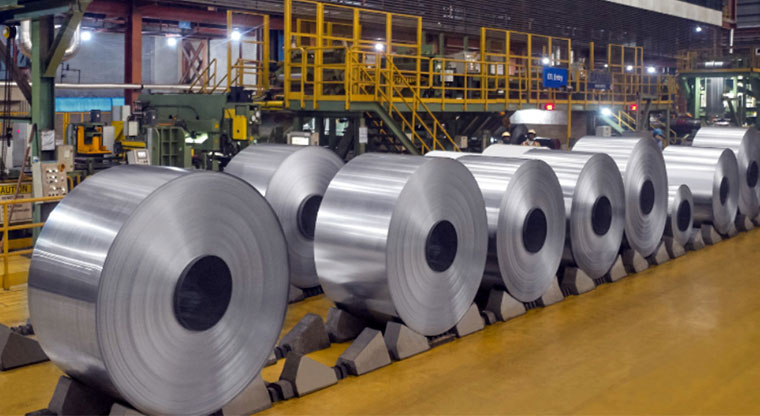
Every fabrication unit in India makes the same decision many times a week: which steel to cut, bend, weld, and shape for its projects. In most cases, the answer is hot rolled steel. Not because there are no alternatives, but because it best fits the practical demands of fabrication work, including formability, weldability, structural strength, and availability across standard sizes and grades.
However, many owners and procurement teams use hot rolled steel without fully understanding how to specify it correctly. This often leads to over-specification, where extra cost is spent on unnecessary strength, or under-specification, where the material fails during welding, warps, or does not meet dimensional requirements.
This guide explains the key properties of hot rolled steel, why it performs well in fabrication, where it is most commonly used, and how to choose the right grade for different fabrication needs.
Hot rolled steel is produced by rolling steel above its recrystallisation temperature, the point at which the internal grain structure reforms as the material is shaped. Because of this, the steel does not work harden during processing. It reshapes smoothly without building internal stress.
This process results in a material that is structurally stable, dimensionally consistent, and largely free from residual stresses that could cause distortion during cutting or welding.
For fabrication units, this translates into practical advantages. Hot rolled steel cuts cleanly using plasma, flame, or mechanical shearing. It bends in a predictable manner on press brakes and rolling machines. It also welds easily without the need for preheating that higher carbon steels often require.
It is available across a wide thickness range, from light gauge sheets to heavy plates above 100 mm, making it suitable for nearly all structural fabrication applications.
The advantages of hot rolled steel in fabrication come directly from the hot rolling process itself. These properties explain why it is widely used and how fabricators can avoid common processing issues.
Hot rolled steel in IS 2062 E250 grade offers elongation of around 20 to 23 percent. This allows the material to be bent, pressed, and formed without cracking at the bend radius, making it highly suitable for shaping operations.
IS 2062 grades from E250 to E450 provide defined yield strength values that engineers can design with confidence. Every coil or plate meets a minimum specified strength, which is critical for structural fabrication.
With a low carbon equivalent of up to 0.42 in E250, hot rolled steel can be welded using standard processes without preheating in most normal conditions. This makes it practical and efficient for fabrication environments.
Because the steel cools naturally after rolling, internal stresses are low. This allows it to bend predictably on press brakes with minimal springback compared to cold rolled material of similar thickness.
Hot rolled steel can be cut cleanly using plasma, oxy fuel, laser, or mechanical shearing. While surface scale needs to be cleaned at weld joints, the base material itself cuts without cracking or irregular edges.
It is available in a wide range of forms including coils, plates, and structural sections. Thickness ranges from 1.5 mm to 150 mm and widths exceed 2,000 mm, making it suitable for nearly all fabrication requirements from a single material system.
For a fabrication unit handling multiple components every day, weldability is more than a material feature. It directly affects productivity. Time spent on preheating joints, controlling inter-pass temperatures, or fixing hydrogen cracking in the heat affected zone reduces overall output.
Hot rolled steel in IS 2062 E250 and E300 grades helps avoid these issues under normal fabrication conditions. Its low carbon equivalent reduces the risk of hardening in the heat affected zone, which in turn prevents brittleness and cracking. Weld spatter remains manageable, root penetration is consistent, and welds can typically be inspected without the need for additional non-destructive testing often required for higher alloy steels.
Best welding practices for Hot Rolled Steel in fabrication:
Hot rolled steel forms the backbone of India’s fabrication industry, with IS 2062 grades widely used across structural and industrial applications. IS 2062 E250 and E300 are the most common specifications for general structural work due to their balanced strength and workability.
Columns, beams, trusses, portal frames, mezzanine floors, industrial platforms, and crane gantries are all3commonly built using IS 2062 hot rolled plates and sections. These grades provide the strength and reliability needed for core structural systems.
Machine bases, frames, conveyors, guards, hoppers, and support structures are typically made from hot rolled steel because of its consistent strength and ease of fabrication within tight tolerances required for machinery installation.
Farm equipment such as ploughs, cultivators, seed drills, trailer bodies, and water tank stands rely on hot rolled steel for its cost efficiency, adequate strength, and ease of forming in high-volume production.
Truck bodies, trailers, bus structures, tipping bodies, and container frames are commonly fabricated using IS 2062 plates and angles. Thickness ranges from 3 mm to 12 mm cover most vehicle structural requirements, while weldability supports long continuous joints.
Racking systems, storage bins, hoppers, shelving, and industrial tanks use hot rolled steel for its load-bearing strength and structural rigidity, along with reliable weld performance for complex assemblies.
Highway barriers, railings, bridge components, water tank structures, and utility frames are typically made using IS 2062 E250 sections and plates, making it a standard choice for civil infrastructure fabrication across India.
IS 2062 is the primary standard for hot rolled structural steel in India. Here’s a practical grade reference for fabrication unit procurement.
| IS 2062 Grade | Min. Yield Strength | Min. UTS | Max CE | Fabrication Application |
|---|---|---|---|---|
| E250 (Grade A) | 250 MPa | 410 MPa | 0.42 | General structural fabrication, agricultural equipment, light frames |
| E250 (Grade BR) | 250 MPa | 410 MPa | 0.42 | Bridges and structures requiring charpy impact testing |
| E300 | 300 MPa | 440 MPa | 0.42 | Medium-duty structural frames, equipment bases, vehicle bodies |
| E350 | 350 MPa | 490 MPa | 0.45 | Heavy structural sections, crane gantries, heavy plant fabrication |
| E410 | 410 MPa | 540 MPa | 0.45 | High-strength structural elements, heavily loaded frames |
| E450 | 450 MPa | 570 MPa | 0.46 | Specialised structural applications with high load requirements |
For most general fabrication work such as light to medium structural steel, agricultural equipment, vehicle bodies, and industrial frames, IS 2062 E250 Grade A is the most suitable and cost-effective choice. It offers the right balance of strength and workability for everyday fabrication needs.
E300 is used where higher load requirements demand extra strength without moving into the higher carbon equivalent of E350 and above. Grades E350 and higher are typically reserved for heavy structural applications where higher yield strength is needed to reduce section size and overall weight.
For fabrication units, profitability depends heavily on consistent material quality. Variations in thickness, chemistry, or mechanical properties can lead to warped parts, weld failures, and costly rework or customer rejection.
Avoid generic terms like “structural HR steel.” Always specify the exact IS 2062 grade. E250 Grade A is suitable for most fabrication work, while higher grades should only be used when structural requirements demand them.
The Mill Test Certificate (MTC) confirms key properties such as yield strength, tensile strength, elongation, and carbon equivalent for the exact batch supplied. Without it, there is no reliable proof that the material meets specifications.
IS 2062 defines allowable thickness tolerances, and maintaining them is essential for accurate cutting, bending, and assembly. Material outside tolerance should not be adjusted during fabrication, as it affects final dimensional accuracy.
BIS certification under IS 2062 ensures the manufacturer’s process is independently verified. It remains one of the strongest indicators of consistent quality across batches.
For welding applications involving thickness above 25 mm or low ambient temperatures below 5°C, check the carbon equivalent of the selected grade. Higher CE increases preheating requirements and affects fabrication efficiency.
In India’s fabrication industry, hot rolled steel is the most widely used material because it is engineered to meet real fabrication needs. Its formability allows complex shapes without cracking, its weldability ensures strong and reliable joints, and its structural strength makes it suitable for both light and heavy applications. With availability across IS 2062 grades from E250 to E450, it covers most fabrication requirements in a single material family.
The difference between a smooth-running fabrication unit and one that faces repeated issues often comes down to specification discipline. Using the correct IS 2062 grade, insisting on Mill Test Certificates, and sourcing from verified manufacturers helps reduce variability, rejections, and structural concerns.
JSW Steel IS 2062 hot rolled steel range, supported by integrated manufacturing, BIS certification, and wide distribution through direct channels and JSW Steel for SME, provides a reliable and consistent material solution for fabrication units of all sizes.
View all news


